+919807569224
bipinyadav280803@gmail.com

SEO in 2026 looks very different from what worked even two years ago. Small businesses are no longer competing only for Google rankings — they are competing for visibility inside AI-generated answers, local search experiences, video platforms, Reddit discussions, and conversational search tools like ChatGPT and Perplexity.
The good news is that small businesses can still win. In many ways, the shift toward helpful, trustworthy, and experience-driven content favors smaller brands that understand their audience better than large corporations do.
Here’s what is actually working now.
Traditional SEO focused heavily on keywords, backlinks, and publishing as much content as possible. That approach is fading fast.
Search engines and AI systems now prioritize:
AI-generated search summaries are appearing in more searches every year, especially informational queries.
That means users often get answers without clicking websites at all.
Small businesses that still rely on generic blog posts written purely for traffic are seeing declining results. Businesses that focus on authority, clarity, and conversion-focused content are growing faster instead.
The biggest mistake small businesses still make is chasing high-volume keywords instead of high-intent searches.
A local roofing company doesn’t need to rank for “what is roofing.” It needs to rank for:
Intent-driven content converts better because it targets users ready to take action.
Modern SEO rewards relevance over volume. Search engines are much better at understanding why someone searches, not just what they typed.
Publishing dozens of unrelated posts no longer works.
Instead, successful small businesses build topical clusters around their services and expertise.
Example for a digital marketing agency:
Each page should support the others through strong internal linking.
Search engines now evaluate topical depth and entity relationships rather than isolated keywords.
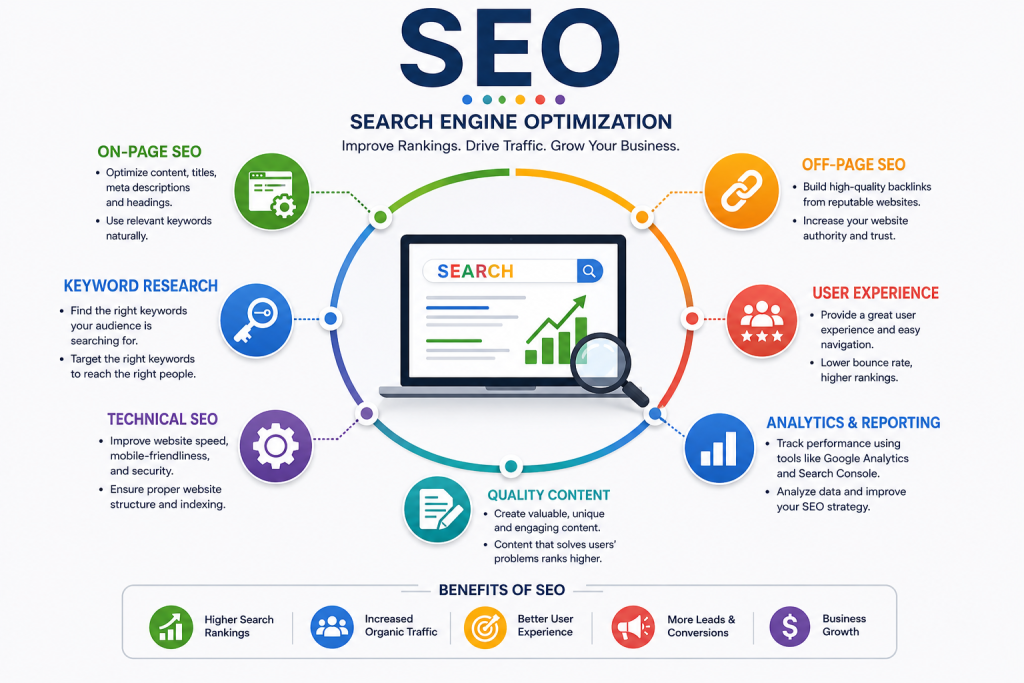
AI tools are everywhere in 2026, but businesses using AI without human insight are struggling.
Many AI-generated websites sound identical because they use the same prompts, same structures, and same recycled information.
What works now is:
AI should speed up execution — not replace expertise.
Businesses producing fully automated “SEO blogs” are seeing weak engagement and lower trust signals. Meanwhile, brands combining AI efficiency with human experience are standing out.
A major shift in 2026 is the rise of AI-driven search experiences.
People now search using:
This has created a new discipline called Generative Engine Optimization (GEO) or Answer Engine Optimization (AEO).
The goal is no longer only ranking pages.
The goal is becoming the source AI systems trust and cite.
Structured data helps AI systems understand:
Content should quickly answer:
AI systems increasingly value unique insights and trustworthy sources.
Despite all the AI hype, local SEO remains one of the highest ROI channels for small businesses.
Many AI-driven searches still rely heavily on:
In fact, local-intent searches are still dominated by traditional local search ecosystems.
Instead of one generic service page:
Reviews influence:
Traffic alone means nothing anymore.
The best-performing small businesses treat SEO as a revenue channel, not a vanity metric.
That means:
A page ranking #1 with poor conversions is less valuable than a page ranking #4 that generates leads consistently.
YouTube Shorts, Instagram Reels, and TikTok now influence search visibility.
Many users search visually before visiting websites.
Small businesses should:
Google increasingly blends video results into search experiences, especially for tutorials, reviews, and local services.
Google continues rewarding:
To improve trust signals:
Anonymous AI-written websites with no real identity are struggling to compete.
Many businesses waste time publishing endless new articles while ignoring older content.
In 2026, updating existing content often produces faster SEO gains.
Refresh:
Google favors fresh, maintained content over outdated pages.
Stop obsessing over:
Focus on:
SEO is becoming harder to measure because AI systems answer many questions directly in search results.
The businesses winning today measure business outcomes — not just clicks.
Here’s the simplified strategy that works now:
SEO is not dead in 2026. Low-quality SEO is.
Small businesses still have a major advantage because they can move faster, create authentic content, and connect directly with their audience.
The businesses succeeding today are not publishing the most content. They are publishing the most useful content.
The future belongs to brands that combine:
That combination is what actually works now.


bipinyadav20030828@gmail.com

108 tilgori chail kaushambhi 212202 UTTAR PRADESH